mercredi 12 janvier 2011

Expedia affiliate program

With Expedia affiliate program you can earn up to 12% on the sale amount. The Expedia affiliate program includes text links, buttons, banners, products catalog, HTML searching tools, emailings to put in your site and connect it to Expedia site.


Here is the detail of the commissions fees:


tableau des rémunérations

Amazon affiliate program

If you choose to use Amazon as an affiliate program you have different options:
  • you can put a link to amazon in your site so that visitors can have access to Amazon site from your own page and you receive a 15% commission on all the purchases your visitors make on Amazon site thanks to your link. You can create a link on a specific product sold on Amazon site with information about that product or use links (banners) to amazon product categories and promotions
  • you can also include widgets in your site. Widgets are a kind of interactive applications from Amazon. For example, one of these widgets enable your visitors to look for information about or buy products from Amazon without leaving your page. Another one helps your visitors to download music, etc... By adding Amazon widgets in your page, you can get up to 10% in referral fees.
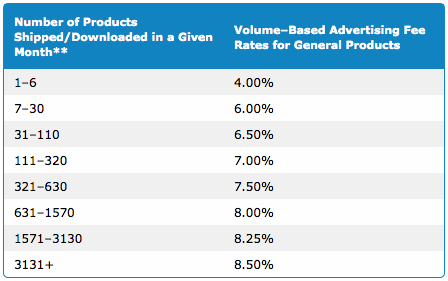
  • Here is the detail of the commission fees provided by Amazone:
Referral Rates
Volume-Based Advertising Fee Rates for General Products

Referral Rates

dimanche 9 janvier 2011

The use of localisation in the web

Géolocalisation et marketing

Fidéliser sa clientèle

http://www.journaldunet.com/ebusiness/crm-marketing/geolocalisation-et-marketing/fidelisation.shtml

This article refers to the topic of geolocalisation in the web and the use of this tool by brandnames to get loyalty from their consumers. Geolocalisation consists in indicating to yours friends where you are via the web in your cell phone or where you can find some specific places (restaurants, hotels...). This can seem to be quite a commonplace tool at first sight, but brandnames have quickly understood they could deeply impact their customers through the use of it. For example, Starbucks was the first company to use Foursquare - a site dedicated to geolocalisation - to increase loyalty among its clients by giving them the opportunity to collect points each time they prove their presence in a Starbucks restaurant with a "check-in" in Foursquare and offering them some promotions on products when they got a certain amount of points. Such a process encourages consumers to go to Starbucks coffees on a long-term basis as it rewards them for their loyalty.

Geolocalisation is not only use to keep loyalty from customers but also to spread the image of brandnames among a large scale of people. By localising themselves in a specific places, customers let know their friends the name of places where they are used to or like to be and in a sense they invite people to join them into the indicated places. Consequently, without any effort nor any expenses, brandnames can rely on localisation sites on the web to do their own advertising. Thanks to sites like foursquare, brandnames can all the more have access to a wide number of people that "check-ins" are often shared in very famous social networks such as Facebook or Twitter.

Google Places - another localisation site - can also help companies to spread the image of their brandname on the web. Indeed, brandnames can use Google Places to show the way to their selling points, to add a link  which is directly connected to their website and to create tags on their page in Google Map to lead to ads about their product. Thus, the presence of brandnames on the web is largely developped through the use of localisation tools.

As far as hotels are concerned, they unfortunately do not make enough profit from localisation sites. Hotels often use Google Map or Google Places in order to help their clients to localise them on a map and to have easily access to their website. But contrary to brandnames like Starbucks, they usually do not take into account sites like Foursquare to keep loyalty from their clients or to increase their reputation among customers. If hotels want to be able to compete with third parties such as Tripadvisor or with other brandnames, they should rely more on localisation tools to develop their presence and spread their image on the web.
 

lundi 27 décembre 2010

Social media and email marketing


In his article, Raphael Savy stresses the importance of combining the use of both emails and social media to enhance marketing strategies and develop the impact of companies’ brand name on consumers.

Indeed, these web tools have a different and complementary purpose. With a page dedicated to their brand on social media such as Facebook or Twitter, companies have access to a large scope of consumers and can create a web community around their brand. Consumers are particularly fond of social media because they can share advices on products with other customers via forums as well as get quick information on products and promotion sales.

As far as emailing is concerned, the process is completely different. Emails aim at providing a more detailed and personalized message to consumers. In a sense, they are a good way for companies to enter the private sphere of consumers and to adapt their communication to each client in order to reach loyalty. It implies a particular approach from part of companies toward their customers.

Consequently, companies have a great interest in using both social media and emails to reach their clients and keep loyalty. By now, companies rather use social media and emails in a traditional and separate way. The purpose of Raphael Savy is to demonstrate that companies would earn more market shares if they could combine these tools and interconnect them. For example, companies could include Facebook or Twitter shares in their emails in order to spread their brand name to friends or followers of their consumers on social media. Companies could also publish membership forms in their Facebook and Twitter pages so that they could have access to their clients’ email addresses and send them targeted newsletters.

I am personally convinced that companies would improve their marketing strategies and revenues by mixing social media and emailing rather than dealing with them as if they were different marketing segments. Of course, each of these web tools has its own specificity and purpose but it does not mean that they can not be considered as complementary and integrated in a whole marketing policy. This is all the more true that both social media and emails are now accessible on more and more supports such as computers, smartphones and netbooks. Thus, the target market becomes wider and wider and it would be a pity not to make profit of it.

vendredi 10 décembre 2010

Hoteliers' misinterpretation of customers reviews

In his article How to use negative reviews to effect positive change in your hotel, Daniel Edward Craig tackles the impact of negative customers’ reviews on hotels’ reputation and suggests solutions to turn them into positive action. The whole article proves that hotels’ reputation is not only about quality of service but also about communication.

Indeed, hoteliers are considerably concerned with online reviews and it turns out that they even hire people to pass themselves off as customers and write positive comments about their hotel on the web. I consider that such a plan of action is totally irrelevant for two main reasons.

First, this kind of dishonest behaviour has strongly been disparaged by most of consumers associations and magazines. Therefore, the use of fake reviews by hoteliers is not a secret anymore and customers cannot be deceived as easily as before. Parts of customers do not only refer to online reviews to select hotels because they are aware that these criteria are not actually reliable. Customers also know that people giving their opinion on the web tend more to express disappointment than satisfaction as it is a typical human feature.

Secondly, hoteliers make a serious mistake by focusing on the impact of negative reviews on their reputation rather than by improving their own means of communication. All fake positive comments they can publish online will never erase customers’ complaints. As customers can have access to the description of all quality services provided by hotels on their websites or brochures, they usually pay more attention to negative comments when they skim through online reviews in order to see how they contradict the praised image of hotels. Nevertheless, I think that customers would really appreciate if hoteliers made the effort to answer to negative users’ reviews instead of reacting with fake positive comments because it would prove that hoteliers take into account their clients’ complaints and commit themselves to improve their services in accordance with the desires of their customers.

Thus those considerations show that hoteliers need to be more imaginative in the way they communicate with their customers. The more they will create presence on the web, the more they will be able to face negative reviews, the more their popularity will increase.  


samedi 4 décembre 2010

Airline challenges for future


A recent study has been carried out in order to bring out future travel trends and the new growth or revenue opportunities they could create. When looking at the main points developed in the study, it clearly appears that airlines will have to face different challenges if they want to keep growing despite the results of the financial crisis and social changes on travel consumption.

According to the study, Asia will represent the main destination as well as the region that will provide the most increasing rate of future tourists by 2020. Consequently, to anticipate such a demand, airlines will doubtless have to look for new routes and swell the number of aircrafts dedicated to Asian countries.  

Moreover, new influxes of tourists with different expectations will use air transport. As life expectancy is increasing in western countries, travelling people will get older and be able to spend more time in leisure and holidays. In addition, because of their rising standard of living, inhabitants from emerging countries will probably represent a large part of future travellers as well.

If airlines want to reach all these new potential customers, it is by now necessary to carry out market surveys on these different segments of population in order to target their specific expectations and needs while travelling. Then airlines will have to adapt their existing ground installations and offers. For example, they could implement personalised services for old people who usually need careful attention from air personnel or provide more comfortable cabin classes.

Broadly speaking, airlines will have to pay attention and meet the requirements of customers who long for new travel experiences. The study notably stresses the need to expand partnerships between rail and air transport so that customers can be taken on by travel agents without an interruption during their whole travel. Such partnerships will obviously have to be complemented with the development of industry niches and expert agents who will be able to provide advices and services compatible with their customers’ desire of new travel experiences.

Therefore, airlines will have to take all these changes into consideration if they want to play an active role in new travel trends and make their activities thrive in accordance with their new customers’ habits.